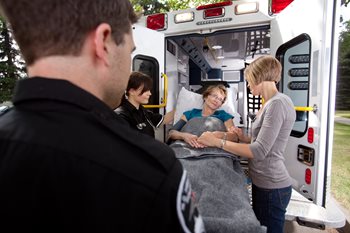
Geriatric Patient Assessment: A Practical Guide for EMS Providers
Through case-based scenarios and evidence-based strategies, participants will learn how to adapt their assessment techniques to improve accuracy and patient outcomes. Topics include communication barriers, sensory and cognitive impairments, polypharmacy, and recognizing subtle signs of acute illness such as dehydration, infection, and cardiac events. By the end of this course, EMS providers will be better equipped to conduct thorough, patient-centered assessments, recognize high-risk presentations, and make informed clinical decisions when caring for older adults in the prehospital setting.
Objectives
Upon completion of this course, the participant should be able to:
-
Identify characteristics of geriatric patients that contribute to atypical or vague presentations of illness.
-
Differentiate between normal aging changes and signs of acute illness in geriatric patients.
-
Identify common assessment challenges related to chronic illness, sensory impairment, and atypical presentations.
-
Determine appropriate communication strategies and assess decision-making capacity in geriatric patients.
-
Identify high-risk findings and red flags that indicate the need for further evaluation or transport.
Curriculum
Chapter 1: Understanding the Geriatric EMS Patient
-
Demographics and growth of the geriatric population in EMS
-
Common chronic conditions and multimorbidity
-
Living environments and social determinants of health
-
EMS utilization trends and higher acuity presentations
-
Differentiating normal aging vs. disease processes
Chapter 2: Physical and Physiological Challenges in Assessment
-
Impact of chronic illness on assessment and presentation
-
Sensory impairments (hearing, vision) and communication barriers
-
Atypical presentations of acute illness (MI, infection, stroke)
-
Dehydration, fatigue, and subtle clinical clues
-
Pain assessment challenges and non-traditional symptom reporting
Chapter 3: Environmental, Medication, and Psychosocial Barriers
-
Scene-related challenges (noise, distractions, home conditions)
-
Polypharmacy and medication-related complications
-
Mental health considerations (depression, anxiety, suicide risk)
-
Social isolation, caregiver dynamics, and neglect concerns
-
EMS-induced discomfort and its impact on assessment
Chapter 4: Communication and Modified Assessment Strategies
-
Effective communication techniques for older adults
-
Adjusting assessment approach for cognitive or sensory deficits
-
Managing difficult interactions (confusion, silence, agitation)
-
Gathering accurate history from patients and caregivers
-
Building trust, rapport, and improving patient cooperation
Chapter 5: Case-Based Application and Clinical Decision-Making
-
Integrating assessment findings into clinical decision-making
-
Recognizing high-risk presentations and subtle red flags
-
Managing refusals and assessing decision-making capacity
-
Case studies highlighting real-world EMS challenges
-
Prioritizing transport and treatment in complex geriatric patients
Price: $12.00
Contact Hour: 1
Course Author

Brad Moore
Brad Moore is a dedicated public safety professional with over 18 years of service in emergency response. He has been a firefighter since 2021 and became a licensed paramedic in 2023, providing critical care in high-pressure situations. Before transitioning to Fire and EMS, Brad served for 12 years as a police officer, where he developed strong skills in leadership, crisis management, public safety, and community service. He is also a licensed EMS Instructor through the Texas Department of State Health Services, further extending his expertise in training and education for emergency responders.
Course Accreditation
Provider approved by the Texas Department of State Health Services, course provides 1.00 contact hour(s). CE Program Approval Number #: 601011.